
Agricultural chemical products such as fertilizers are key to ensuring the abundance of American agriculture, but they come with a plot twist: They can also sometimes have unintended consequences. New research in detecting and mitigating unplanned impacts from chemicals and microbial pathogens is helping improve the safety and well-being of all Americans.
In February 2026, an executive order designated elemental phosphorus and glyphosate — irreplaceable components of herbicides and defense technologies — as critical assets to national security. Not long after, the war in Iran disrupted delivery of essential fertilizer. These events underscore the importance of managing agricultural chemical supply chains and pathogens to ensure the security, safety and well-being of America and its service members.
“In recent years, both as a society and within the ag industry, we have begun to dive deeper into the intersection of traditional national security and agricultural interests, particularly in the overlap of chemical use, supply chains and health impacts,” said Meghan Jackson, director of the food, agriculture and environment security (FAES) focus area, a strategic partnership between the National Strategic Research Institute (NSRI), the University of Nebraska–Lincoln (UNL) and the Institute of Agriculture and Natural Resources (IANR).
“We all depend on a successful and healthy American agricultural system. Disruptions to that critical supply caused by chemical interactions or pathogens can have downstream effects. Nebraska researchers are making substantial impacts across all these areas, building on more than a century of commitment to advancing agriculture.”
NSRI is one of only 15 University Affiliated Research Centers (UARCs) in the country designated by the U.S. Department of War (DOW). The institute provides perspective and clarity regarding the evolving national security concerns of federal government stakeholders. NSRI partners with IANR to leverage 150 years of experience in agricultural research and a deep commitment to producers and consumers for research and development that matters to the DOW and beyond.
“NSRI staff bring deep knowledge on challenges facing agricultural production and maintain strong connections with federal partners,” said Dr. Xu Li, Dale Jacobson and Debra Leigh Professor of Environmental Engineering at UNL. “NSRI helps UNL researchers frame research questions that address national security issues across agriculture and the environment, and it facilitates connections to potential funding.”
With additional partners, NSRI and IANR train military and civilian responders to mitigate the impacts of biological pathogens, develop new ways to detect and mitigate agricultural chemicals and invent nonchemical alternatives.
Enhanced Detection & Sensing for Resiliency Against Chemical and Pathogen Threats
Before the consequences of chemicals and pathogens can be mitigated, they must be detected. Some compounds occur in concentrations so low or sparse that existing systems are unable to reliably detect or process them. Several research projects at the University of Nebraska aim to close this gap.
Dr. Mike Boehm, professor in the UNL Department of Plant Pathology, and his team are using plants as biosensors in collaboration with Teledyne Scientific through the Defense Advanced Research Projects Agency (DARPA) eX Virentia program. The analytical tools and curated datasets developed through this effort will enable scalable prediction of plant responses and establish a scientific foundation for future plant‑based sensing systems.
Such systems could support early detection and monitoring of environmental chemical exposures across large geographic areas by leveraging native vegetation and remote sensing technologies.
Per‑ and polyfluoroalkyl substances (PFAS) have been widely used since the 1950s for their heat‑, water‑ and grease‑resistant properties. These traits made PFAS valuable in both civilian and military applications, such as manufacturing, but the compounds can bioaccumulate over time and now persist in the environment at extremely low concentrations that may negatively affect health. Organizations across sectors are working to remove and replace PFAS to reduce potential impacts while maintaining safety and readiness.
Dr. Nirupam Aich, associate professor of civil engineering at UNL, is leading research to improve detection and mitigation strategies for PFAS. His work focuses on identifying the presence of PFAS in environmental systems and developing approaches that can help reduce associated risks.
Antibiotic resistant bacteria and pathogens can be as hard to detect as PFAS in the environment. Dr. Li is a respected expert in this area. He spent more than a decade investigating antibiotic resistance in agricultural ecosystems and led a wastewater surveillance research program examining hotspots of the SARS-CoV-2 virus during the COVID-19 pandemic within Lincoln.
“Microbial pathogens — both known and emerging — pose a significant threat to livestock and crop production,” Dr. Li said. “Infection can lead to reduced yield and substantial economic losses. The pathogens’ diluted and sporadic occurrence poses a significant challenge for developing early warning systems across broad geographical regions. Our watershed-scale environmental surveillance systems are essential for early detection.”
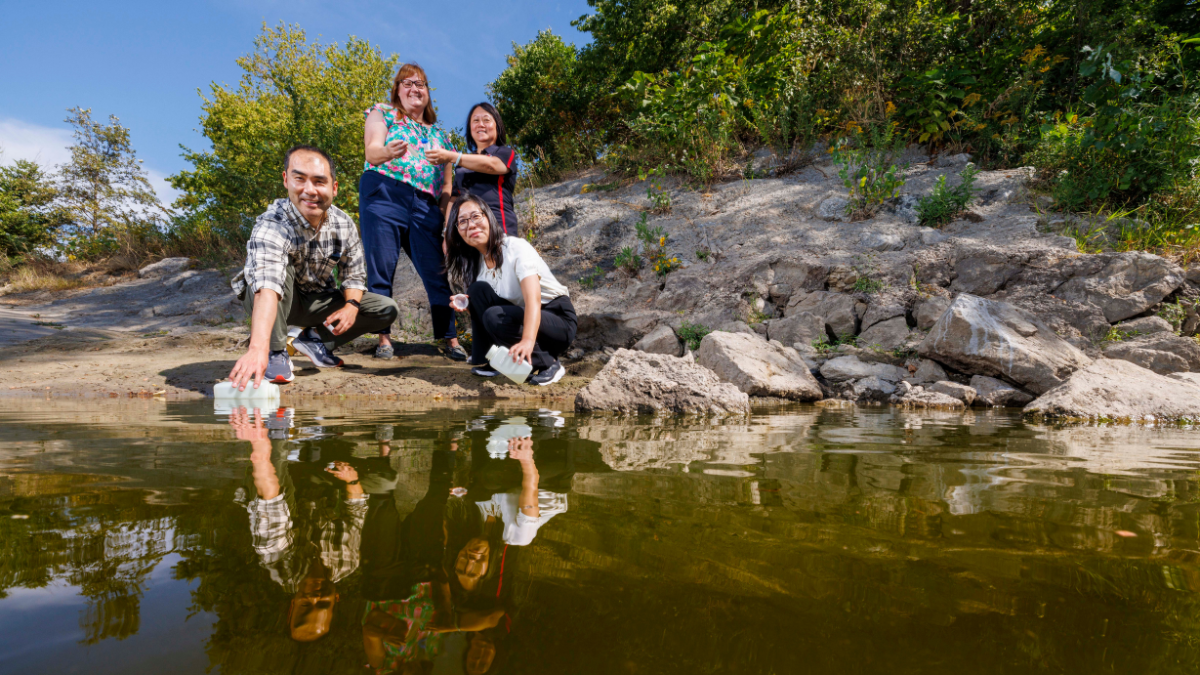
Dr. Li and NU colleagues have developed a low-cost passive sampling system to efficiently collect environmental DNA (eDNA) from surface water. The samplers are currently being used to detect highly pathogenic avian influenza virus and show promise for monitoring both endangered and invasive species and other pathogens of interest.
The team recently received a prestigious “Awardable” designation from the DARPA for the sampler design, which brings together expertise in engineering, computer science, microbiology, veterinary diagnostics and crop science.
In another project, Dr. Li is developing an environmental surveillance system to detect antibiotic-resistant bacteria in the environment. Antibiotic resistance reduces effectiveness of treatments in humans, livestock and crops. Expanding this work to mitigation, the researchers designed a heated concrete pad that can be used to inactivate antibiotic resistant bacteria and other pathogens in livestock wastes.
Dr. Daniel Snow, research professor and director of the University of Nebraska Water Sciences Laboratory, is capitalizing on the core facility at the Nebraska Water Center, using specialized equipment in collaboration with biologists and engineers, to examine the impacts of pharmaceuticals, antibiotics, PFAS, pesticides and their degraded products on the environment and human health — including on military bases. He has also developed new detection methods to measure and use stable, radioactive isotopes as tracers to study environmental problems and processes.
Targeted, Data-Backed Methods to Reduce Risk
Agricultural chemical, pathogen and pollutant risk comes down to exposure, which can occur directly or indirectly for agricultural workers and communities through their interactions with the environment, especially with groundwater and surface water.
Researchers at the University of Nebraska and NSRI are working to mitigate this risk by finding ways to limit the impacts and routes of exposure.
Dr. Amy Desaulniers, associate professor of reproductive physiology at the UNL School of Veterinary Medicine and Biomedical Sciences, examines how environmental exposures affect livestock reproductive performance, a critical factor in agricultural stability and food system resilience. Using pigs as a well‑established model for livestock biology, her team studies how specific chemicals influence key developmental processes that determine long‑term herd productivity.
“Understanding where exposure occurs and how it affects developing organ systems helps us make better decisions to protect both animal health and the agricultural industry,” Dr. Desaulniers said. “This research supports producers by identifying when livestock may be most vulnerable and what strategies can reduce risk.”
Her current work focuses on atrazine, a widely used and highly effective herbicide that is also known to disrupt hormone signaling. While advanced drinking‑water treatments such as reverse osmosis can remove atrazine, they are often cost‑prohibitive at the farm scale.
More accessible approaches include routine water monitoring, maintaining modern well construction standards and using lower‑cost filtration options such as granular activated carbon.
“These strategies help improve water quality during sensitive developmental windows,” Desaulniers explained. “By supporting reproductive health in livestock, we help sustain productivity and promote the resilience of agricultural systems.”
Dr. Karrie Weber, professor in the UNL School of Biological Sciences, is studying how naturally occurring uranium in soil and sediment can become more mobile under certain environmental conditions. Her work shows that while uranium in groundwater has often been linked to activities such as mining, milling, nuclear testing and spent fuel disposal, natural sources also contribute to concentrations found across the United States. Nitrates from field‑applied nitrogen fertilizers can bind with uranium in aquifers, increasing its mobility and elevating levels in drinking and irrigation water.
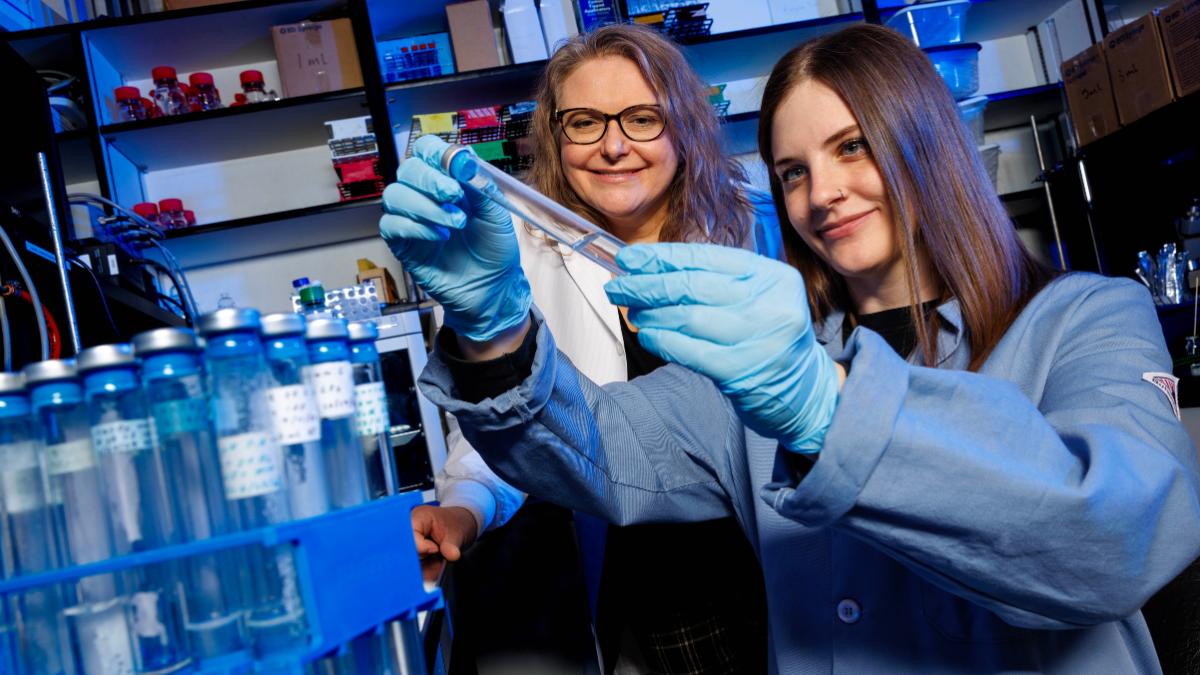
These findings underscore the importance of advanced detection methods developed by researchers like Dr. Snow, whose work helps monitor environmental changes as agricultural production and energy needs evolve.
The Testing Ag Performance Solutions (TAPS) program at UNL, led by Dr. Chris Proctor, extension professor and plant physiologist in the Agronomy and Horticulture Department, helps producers assess chemical applications and the use of precision agriculture techniques in test fields rather than risking their own fields with new strategies or products. The invaluable testing data is shared with other participants to help ensure optimal yields and strengthen food production.
Innovative Alternatives Take Mitigation to New Levels of Effectiveness
Agricultural chemical and pathogen mitigation tactics are not always perfect. There is a continual search for crop enhancement and treatment alternatives that cost less, work better, are easier to implement, cause less collateral harm and can be produced within the United States.
The challenges can be complex.
“Because some of the chemicals are a single molecule, they become ineffective over time because pathogens evolve and become resistant,” explained Dr. Clemencia Rojas, associate professor in the Plant Pathology Department at UNL.
Dr. Rojas and her team have been working on an NSRI-sponsored project to control Bacterial Panicle Blight (BPB) in rice, one of the most destructive diseases in rice cultivation.
One of her graduate students, Shilu Dahal, in 2024, helped identify a beneficial environmental bacterium called Pseudomonas protegens PBL3 that shows antimicrobial properties against Burkholderia glumae, which causes BPB. It may be useful as an environmentally friendly biopesticide for crops other than rice as well.
“These alternative approaches work, and they are healthier for the environment, for people producing food and for people eating the food,” Dr. Rojas said. “This is an important area to study, because microorganisms in the environment represents an untapped resource of useful molecules in agriculture and also medicine.”
Other innovative production and mitigation alternatives being explored by University of Nebraska scientists are designed to significantly reduce the need for chemical or microbial inputs.
Dr. Kiran Bastola, a bioinformatics professor at the University of Nebraska at Omaha with a doctorate in plant biology, uses small growing chambers and a computer system to monitor and control light, water and nutrient intake for growing microgreens, which are some of the most common nutrients in the food system. This innovative grow system not only maximizes growth and quality of produce but also minimizes inputs and reduces the negative environmental and health impacts associated with herbicides, fertilizers and pesticides.
The growth chambers, built using off-the-shelf components, can be easily scaled up in rural and food-insecure places. Additionally, they could provide fresh, nutritious food to troops stationed in austere environments, reducing biosafety concerns that may arise from locally sourced produce.
Ready to Respond
Ultimately, finding new ways of managing the plot twists or impacts of agricultural chemicals, which are absolutely essential inputs to strengthening the U.S. food supply, will hold little meaning unless the fundamental science can be turned into applied solutions.
“Stakeholders and resources across the University of Nebraska System, NSRI and IANR are overflowing with expertise in agricultural chemicals, microbial genetics and synthetic biology,” Jackson said. “We are well-positioned to contribute to the nation's search for actionable agricultural solutions through advances in biosecurity, precision ag and environmental stewardship.”
NSRI and IANR, with leadership, perspectives and insights across the University of Nebraska System’s four campuses, continue to demonstrate their capabilities for discovery and their ability to translate those discoveries to solutions. And they are positioned to take on more.
Get more details about NSRI's food, agriculture and environment security focus area, including the three previous articles in this series, at nsri.nebraska.edu/faes.