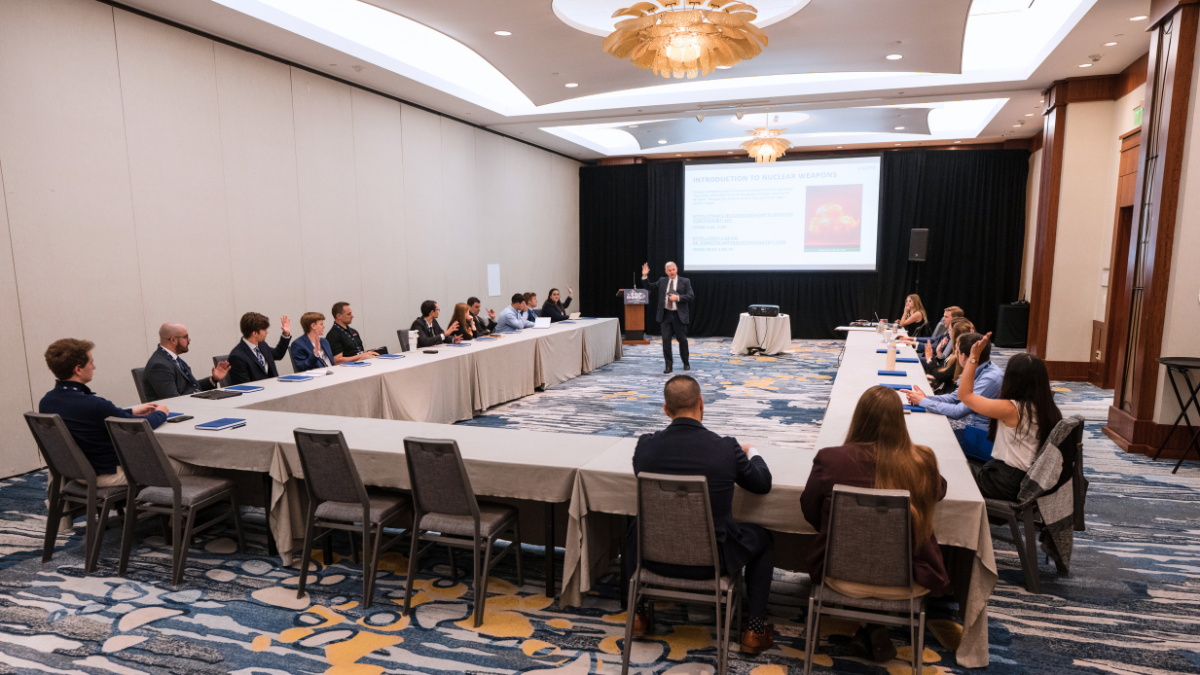
The National Strategic Research Institute (NSRI) at the University of Nebraska strengthened the Nation’s strategic deterrence enterprise by leading a high‑impact training and tabletop exercise during a session for young professionals at the recently held Strategic Deterrence Coalition (SDC) Annual Symposium.
Delivered at a moment of rising geopolitical tension and rapid modernization across global nuclear arsenals, the session equipped emerging defense professionals with the context, decision‑making frameworks and operational realism essential to supporting deterrence credibility and senior leader readiness.
Hosted in Alexandria, Virginia, the symposium convened leaders from industry, government, the military and academia to examine the current state of the U.S. strategic deterrent. NSRI was invited to design and lead the Young Professionals Group Program — a signal from the industry for national security education and workforce development.
“There is a clear demand for foundational training that explains what strategic deterrence is, why it matters and how professionals across the enterprise contribute to it,” said Patrick Rhoads, NSRI research director for nuclear programs. “As the University Affiliated Research Center designated by the Department of War and sponsored by U.S. Strategic Command, NSRI is uniquely positioned to meet that need."
The two‑day event began with a foundational briefing led by Rhoads, who brings decades of executive‑level experience across the nuclear enterprise, including service as a U.S. Navy nuclear officer, senior leadership roles within the National Nuclear Security Administration and extensive work in nuclear operations, policy, arms control technology, forensics, safety and large‑scale acquisition. His insights provided participants with the fundamentals of nuclear weapons, deterrence theory, escalation dynamics, alliance considerations and the history and modernization of the U.S. nuclear enterprise.
With the stage set, participants were then led into a theater‑level tabletop exercise (TTX) developed and facilitated by NSRI consultant Drew Peterson, with Grace Farson, NSRI research specialist, leading materials development, AI‑enabled visual content and session logistics.
The exercise placed participants in a 2028 crisis scenario involving a hypothetical Chinese invasion of Taiwan, tasking them to operate as an executive‑level decision committee under conditions of uncertainty, compressed timelines and escalating risk. Even within limited time, gameplay generated intense debate on strategic‑response options, escalation thresholds, alliance signaling and the friction inherent in high‑stakes consensus building.
Themes that emerged included the importance of credible force posture, the operational implications of modernization programs and the gap between theoretical deterrence constructs and the real‑world pressures of strategic decision‑making.
The following day, NSRI joined senior experts for a broader symposium dialogue and, in conjunction with the participants from the day before, delivered insights from the training. The presentation showcased not only the participants’ rapid learning but also the value of interactive, scenario‑driven education for preparing the future strategic deterrence workforce.
Symposium leaders and attendees — including industry representatives and retired senior government officials — highlighted the value of applying realistic crisis simulations to illuminate how individual roles contribute to national security outcomes.
Participant feedback underscored a “thirst” for accessible yet rigorous training that connects professional responsibilities to the logic, history and operational realities of strategic deterrence.
For NSRI, the event validated demand for a portable, scalable deterrence education capability — one that could reach wider audiences across government, industry and academia. It also supported workforce development by exposing early‑career professionals to decision environments that cannot be replicated in a standard classroom.
The session’s integration of AI‑generated media, operational decision frameworks and cross‑sector engagement offered a model for next‑generation strategic education.
“Participants gained a greater appreciation for why their work matters,” Farson said. “Experiencing decision making under uncertainty helped them see how deterrence posture, communication and strategic choices influence real‑world outcomes.”
The 2026 symposium demonstrated that informed, confident professionals are essential to sustaining deterrence in a rapidly evolving threat environment — and NSRI is a highly qualified resource to deliver the education and expertise they need.
Learn more about NSRI's strategic deterrence and nuclear programs at nsri.nebraska.edu/nuclear.