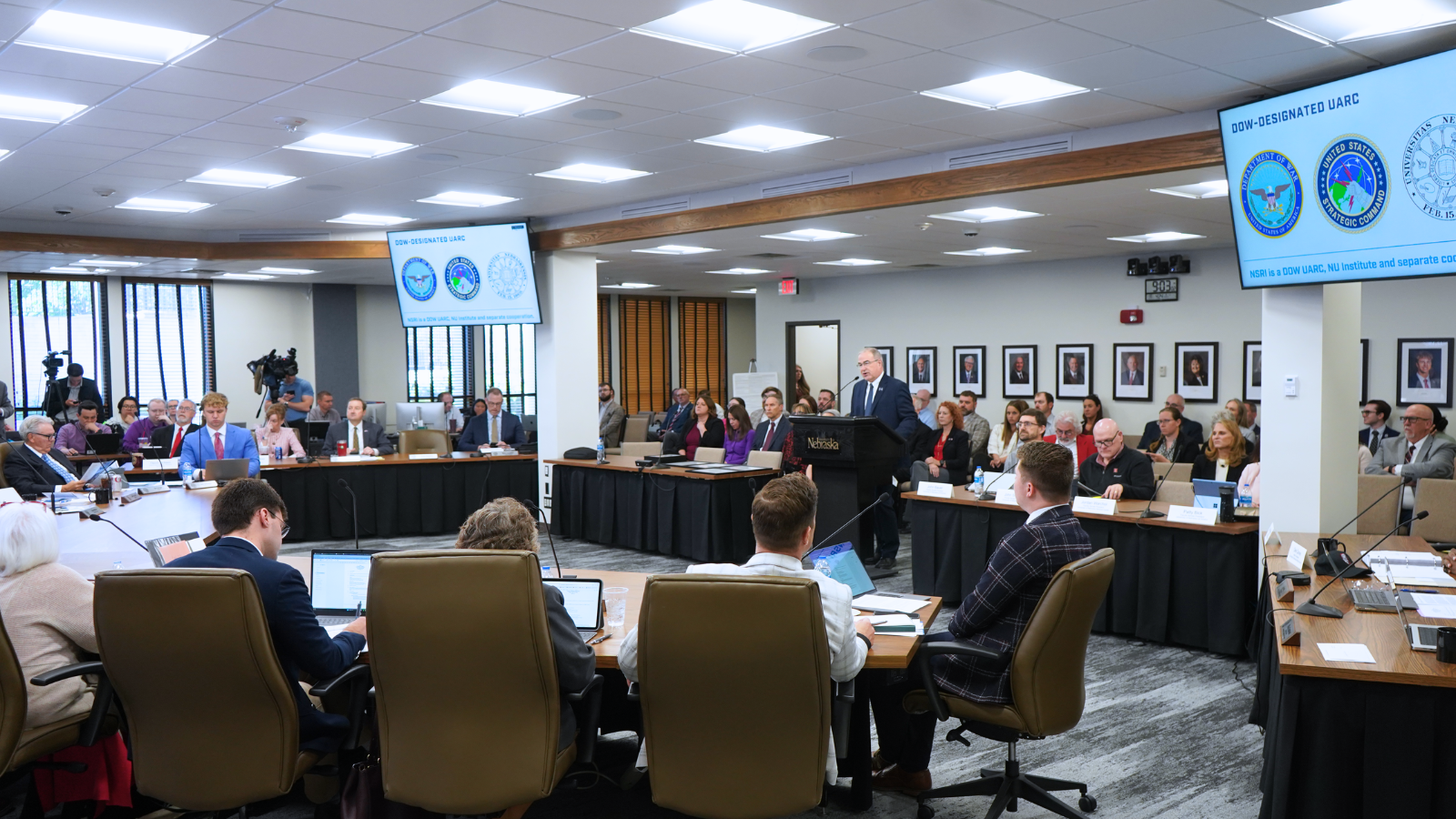
LINCOLN, Neb. — The National Strategic Research Institute (NSRI) at the University of Nebraska (NU) underscored its mission impact and ability to deliver critical national security research during a presentation today to the NU Board of Regents.
As one of the nation’s 15 University Affiliated Research Centers (UARCs) designated by the U.S. Department of War, NSRI continues to strengthen its position as a trusted partner to the federal government in addressing the country’s most complex strategic deterrence and weapons-of-mass-destruction challenges.
“UARCs focus on solving tomorrow’s challenges — so they don’t become today’s threat,” said Maj. Gen., USAF (Ret.) Rick Evans, NSRI executive director, during the 10-minute briefing. “And ultimately, our work delivers capabilities that give warfighters the best chance to accomplish their missions and return safely to their families. For many on the UARC team — especially our veterans and those of us with family members serving in the military — that mission is personal.”
Watch the presentation
Evans outlined three strategic priorities that guide the institute: maintaining the DOW UARC designation for the long term, sustaining U.S. Strategic Command (USSTRATCOM) as the institute’s UARC sponsor and expanding research opportunities for university researchers and students.
“These priorities are directly connected — performance sustains the designation, the designation sustains the sponsors and the sponsor creates opportunity for the university,” he explained.
With the recent renewal of its UARC designation and the award of its fourth indefinite‑delivery, indefinite‑quantity (IDIQ) contract from USSTRATCOM — valued at up to $500 million over 10 years — NSRI has achieved the first two priorities. While IDIQ contracts do not guarantee funding, they establish a framework that enables rapid response to emerging mission needs and accelerates partnership opportunities. This flexible model is a cornerstone of how UARCs sustain relevance to sponsors operating in fast‑moving threat environments.
Since it was established in 2012, NSRI has supported more than 200 contracts and grant awards across its research portfolio. The institute is currently managing 20 active research projects with 68 NU faculty and student contributors so far this academic year.
These projects span mission areas identified by the Department of War, including strategic deterrence, chemical and biological threat detection and countermeasure development, medical countermeasures, threat‑based training and exercise support, and food, agriculture, and environment security. These pre‑defined research areas allow NSRI to accept and execute work quickly — enabling sponsors to access university expertise at the speed of relevance when requirements arise.
Evans highlighted ongoing work at the University of Nebraska Medical Center and University of Nebraska–Lincoln to develop a pre‑treatment therapeutic for acute radiation syndrome (ARS), which has received $35 million in awarded funding since 2017 through the Defense Health Agency. The program aims to protect warfighters and first responders who may need to enter a radiological environment after a nuclear event — a clear example of the mission impact NSRI brings forward.
“This capability does not exist today — Nebraska is developing it,” he said.
He also noted NSRI’s emerging work in Joint Electromagnetic Spectrum Operations (JEMSO), a mission‑critical area for modern defense operations. With NU contributors, the institute is helping develop a range of capabilities and analysis needed to operate effectively in contested and congested spectrum environments — research directly linked to warfighter operational success.
Through its steadfast partnership with USSTRATCOM and other federal sponsors, NSRI provides rapid‑turn, applied research opportunities for University of Nebraska faculty and students, including hands‑on laboratory, field‑based and analytical contributions to national defense missions. This model not only delivers timely capabilities to sponsors but also strengthens the national security workforce pipeline with Nebraska‑trained talent.
“This UARC is an important asset to our nation, bringing distinction to the University and creating unique opportunities for research,” Evans said. “Through this UARC, it is clear that the University of Nebraska is not just participating in national security — we are helping shape it.”
###